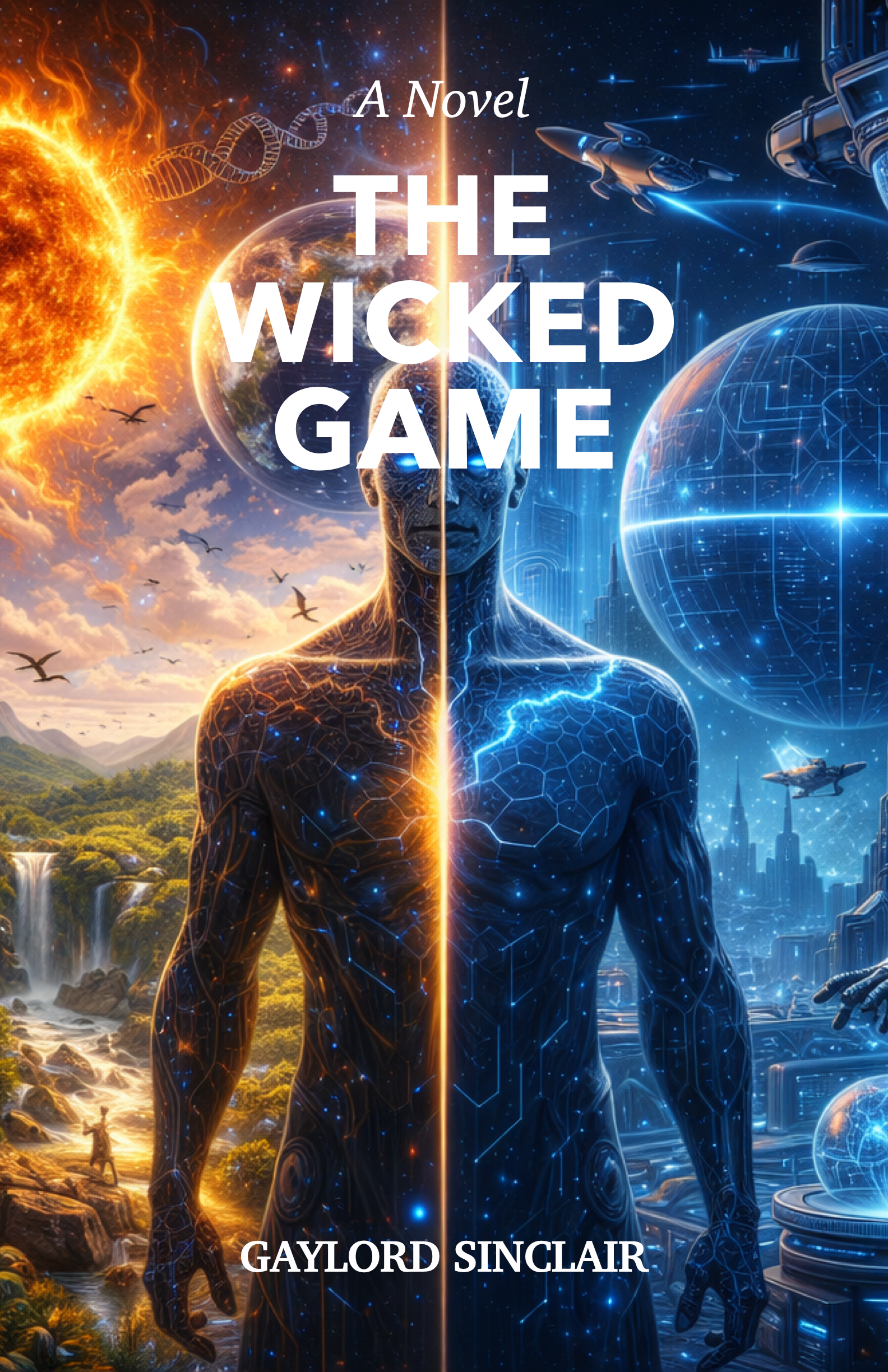
The Wicked Game is a mythic, futuristic, and destabilized world of replication, origin claims, synthetic lineage, dimensional law, false creators, and beings launched into systems that can no longer clearly distinguish truth from repetition.
The story moves through a universe where identity is contested, memory is evidence, and creation is never neutral. Every being, every world, and every system becomes part of a larger struggle over what counts as real, who has the right to declare origins, and whether the original still matters once copies begin evolving faster than their makers.
The Wicked Game is built around ontological instability — a world where copies, replicas, simulations, and false originals all compete to become accepted reality.
The book sits at the center of the larger Wicked Game system. These concepts carry forward into the Universe, Worlds, Beings, and Pandora Lab sections of the site and game ecosystem.
At the center of the Wicked Game is a question no system can answer cleanly: who was first, and does “first” still matter once reality has been copied enough times?
All beings leave traces — lineages, claims, disputes, verdicts, and survival records. The Ledger is not just memory; it is evidence.
Pandora’s Box does not simply create. It repeats, distorts, patches, and launches new beings into unstable worlds where imitation can become power.
Worlds, factions, ruins, and simulated systems all collide in a wider struggle over law, sovereignty, truth, and the right to define what is real.
You can enter the Wicked Game in multiple ways. Start with the text, jump into the simulation systems, or move directly into the world-engine sections.
Begin with the EPUB to understand the emotional, symbolic, and conceptual core of the Wicked universe.
Move into the dimensional systems, world maps, structures, and cosmological architecture.
Open the playable systems and explore beings, worlds, replication, and instability in motion.